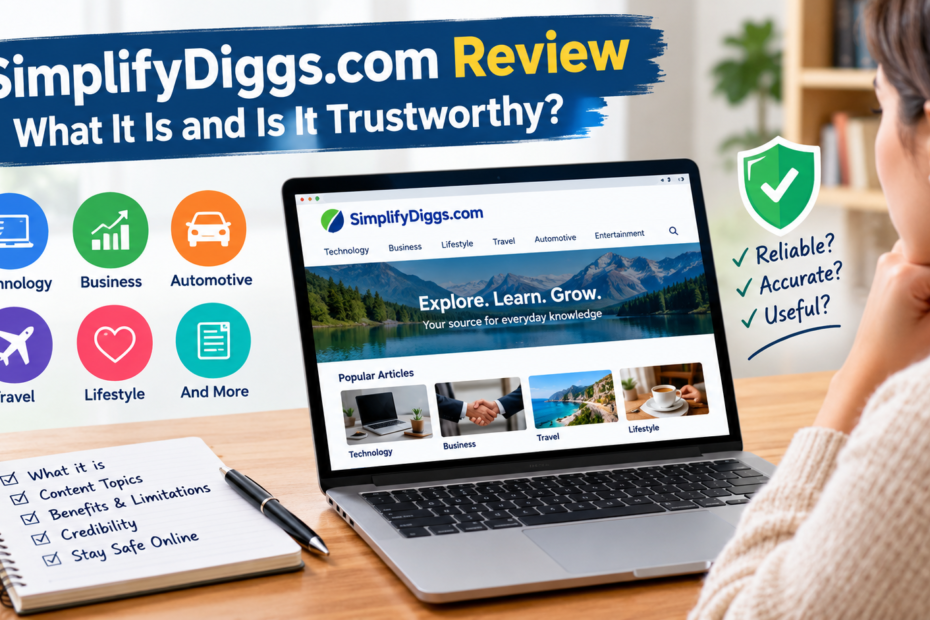
When an unfamiliar website appears in search results, it is natural to wonder who runs it, what it offers, and whether its information deserves your attention. SimplifyDiggs.com is one domain that readers may want to understand before exploring its articles or relying on its advice.
The website is associated with a wide range of subjects, including technology, business, lifestyle, automotive topics, travel, and other general-interest content. This broad approach can make it convenient for readers who want to explore different subjects in one place. However, a large selection of topics does not automatically guarantee accurate information, specialist knowledge, or a consistent publishing standard.
So, what should you know before using this website? This review examines its apparent purpose, content categories, potential benefits, limitations, and credibility signals. It also explains how to evaluate individual articles and protect yourself when browsing unfamiliar websites.
Rather than making assumptions based on appearance alone, the goal is to help you make a more informed decision using practical checks and verifiable information.
What Is SimplifyDiggs.com?
SimplifyDiggs.com appears in public search results as a multi-topic content website. Instead of focusing on a single industry, it publishes or has been associated with articles covering several areas of general interest.
These subjects can include technology, business, finance, automotive topics, lifestyle, travel, entertainment, and digital information. The precise range and depth of coverage may change as the website publishes or updates its material.
This type of publishing model has a straightforward purpose: make information about different subjects accessible through online articles. A visitor might discover a page through a search engine, read an introductory explanation, and use it to decide what to investigate next.
However, it is important to distinguish an informational website from a dedicated digital service. A content website primarily provides material for readers to explore, whereas a software platform or online tool offers specific functionality.
Based on the available public descriptions, the domain is best approached as an informational publishing website rather than assumed to be a specialized application or commercial service.
Information about the site’s legal ownership, editorial team, and internal publishing process should be verified separately. A domain name and a collection of articles alone cannot establish those details.
Why Are People Searching for SimplifyDiggs.com?
People search for unfamiliar domains for several reasons. Some want to understand what a website publishes, while others want to evaluate its credibility before trusting an article.
A search for this domain may reflect several common questions.
- Website purpose: What kind of information does the platform provide?
- Content quality: Are its articles detailed, understandable, and useful?
- Trustworthiness: Can readers verify the information and its authors?
- Online safety: Are there reasons to be cautious when interacting with the website?
- Practical value: Is it a useful starting point for learning about a subject?
These questions are related, but they require different answers. For example, an article can be easy to read without providing enough evidence for an important decision. Likewise, a functioning website is not automatically an authoritative source.
Understanding these distinctions helps readers assess the platform more fairly. Instead of relying on a single overall label, consider what you need from the website and whether its actual content meets that need.
What Topics Does SimplifyDiggs.com Cover?
Publicly indexed pages associate the domain with multiple content categories. Reviewing the individual articles is the best way to establish which subjects receive meaningful coverage.
Technology and Digital Tools
Technology articles can explain software, online services, cybersecurity concepts, cloud computing, and digital trends. This material may help beginners understand unfamiliar terminology before exploring a topic in greater depth.
For example, someone researching cloud storage may want to understand how online file storage works, what synchronization means, and how backup differs from simply keeping files in a folder.
A useful article should explain those differences clearly and identify practical limitations. Technical instructions should also reflect current software versions and security practices.
When an article recommends changing account settings, installing software, or handling sensitive information, compare its guidance with the developer’s official documentation.
Business and Finance
Business content can introduce readers to entrepreneurship, workplace practices, digital business models, and general industry concepts. Financial topics may also appear within a broad publishing model.
These subjects require careful evaluation because inaccurate claims can influence important decisions. An article discussing business trends should support its conclusions with relevant evidence rather than relying on broad statements.
Similarly, readers should not treat general financial explanations as personalized investment advice. Check dates, examine supporting information, and consult appropriate authoritative sources before making financial decisions.
Lifestyle and Everyday Productivity
Lifestyle content often explores organization, daily routines, personal productivity, and practical approaches to everyday challenges.
The most useful articles explain how readers can apply a suggestion. For example, a guide to managing a busy schedule could demonstrate how to prioritize tasks, divide large projects into smaller steps, and review progress.
General suggestions can provide a helpful starting point, but their value depends on the reader’s circumstances. A practical explanation should acknowledge limitations rather than promise that one method works for everyone.
Automotive Information
Automotive articles may discuss vehicle features, maintenance, ownership costs, or developments in the car industry.
Accuracy matters in this category because vehicle specifications and maintenance requirements differ by manufacturer, model, and production year.
Before following technical advice, check the relevant owner’s manual or manufacturer documentation. For repair or safety-related questions, seek qualified assistance when necessary.
Travel and Entertainment
Travel content may introduce destinations, planning ideas, and general travel considerations. Entertainment articles can cover subjects that appeal to casual readers.
However, travel requirements, local rules, prices, and availability can change. Confirm current details through official tourism resources, transport providers, or relevant authorities before making arrangements.
Across all these categories, the same principle applies: a topic appearing in a menu does not prove that the website offers comprehensive or regularly updated coverage of it.
Key Features to Look for in an Informational Website
The usefulness of a publishing platform depends on the quality of its articles and the experience it provides to readers.
The following features offer a practical framework for evaluating the content available on SimplifyDiggs.com.
Clear Navigation and Article Structure
Good organization helps visitors find relevant information without unnecessary effort.
Descriptive headings, short paragraphs, and a logical sequence allow readers to scan an article before deciding which sections deserve closer attention. Clear category labels can also help visitors discover related material.
Nevertheless, a professional-looking layout is only one part of the experience. Readers should assess whether the information beneath those headings actually answers their questions.
Accessible Explanations
Effective informational writing makes unfamiliar subjects easier to understand. It explains necessary terminology, uses examples where appropriate, and avoids unnecessary repetition.
This approach can be especially useful for beginners who want an introduction before consulting specialist resources.
Still, readability and accuracy are separate qualities. An article may sound convincing while containing outdated information or unsupported conclusions.
Relevant Evidence and Examples
Examples help turn abstract explanations into practical knowledge. Supporting evidence gives readers a way to check important claims.
For instance, a cybersecurity guide should explain specific precautions and identify appropriate sources for further guidance. A business article should distinguish established facts from estimates or predictions.
Whenever possible, readers should look for original documentation, credible research, or other sources that directly support the information presented.
Updated Content
Some topics remain relevant for years, while others change rapidly.
A basic explanation of a general concept may require few revisions. By contrast, software tutorials, travel rules, vehicle specifications, and financial information can become outdated.
Publication and revision dates help readers assess freshness, but dates alone do not establish quality. The information itself must still be checked.
These features are standards readers can use to evaluate a website; they should not be taken as confirmation that every feature is consistently present on this particular domain.
How to Evaluate the Content Quality of SimplifyDiggs.com
A useful review should examine the material itself rather than judging a platform solely by its name or design.
Here are five practical checks you can perform when reading an unfamiliar article.
1. Check the Author’s Background
Look for the author’s name, biography, relevant experience, and qualifications where the subject requires them.
These details can help you understand who created the article and whether the person has appropriate knowledge of the subject.
For example, a technical guide involving network security benefits from clear evidence of relevant experience. A specialist medical topic requires a much higher standard of expertise than a general lifestyle discussion.
A byline alone does not prove that an author is qualified. Consider it alongside the article’s accuracy, sources, and depth.
2. Examine the Sources
Important claims should be supported by evidence appropriate to the subject.
Useful references may include official documentation, original research, government publications, recognized professional organizations, or credible industry reports.
Open the references instead of assuming they support the article. Check whether the original source confirms the specific claim being made.
If a page includes precise statistics or strong conclusions without explaining their origin, treat those statements cautiously.
3. Look for Original Value
An article should provide more than a collection of familiar statements.
Original value may come from practical examples, a meaningful comparison, firsthand observations, detailed explanations, or carefully researched findings.
Ask yourself whether the page answers the question fully. Does it explain how something works? Does it address limitations? Does it help you decide what to do next?
If the article simply repeats general information without adding useful detail, another source may provide a more complete answer.
4. Assess Accuracy and Freshness
Check whether the article distinguishes facts from opinions and whether its claims remain current.
For example, an older software tutorial may describe settings that no longer exist. A travel article may mention requirements that have since changed.
Compare time-sensitive claims with current official resources. If the information conflicts with reliable documentation, do not follow it without further investigation.
5. Consider the Article’s Intended Audience
Not every article needs to serve every reader.
An introductory guide may be suitable for someone learning a topic for the first time. However, a professional, student, or specialist may require detailed evidence, precise definitions, and primary sources.
Evaluate the page according to your actual needs rather than expecting a short overview to answer every advanced question.
Is SimplifyDiggs.com Trustworthy?
Trustworthiness depends on evidence, transparency, and the quality of the published information. No single feature can establish all three.
When assessing SimplifyDiggs.com, readers should consider the information available about its publisher, authors, editorial practices, and content sources.
| Trust signal | What readers should check |
|---|---|
| Publisher identity | Is there clear information about who operates the website? |
| Author information | Can readers learn about the writer’s relevant background? |
| Editorial standards | Does the site explain how articles are reviewed or corrected? |
| Supporting evidence | Do important claims link to reliable sources? |
| Content freshness | Are time-sensitive details current and accurate? |
| Commercial transparency | Are relevant paid placements or affiliate relationships clearly disclosed? |
These checks help readers identify what they can verify and where information remains uncertain.
A missing detail does not automatically prove that a website is fraudulent. Equally, a professional design or large number of articles does not guarantee credibility.
There is insufficient independently verified information in this review to assign the entire domain a definitive trust rating. The more responsible approach is to examine individual articles and confirm important claims through reliable sources.
This distinction matters because readers may encounter different types of content on the same website. One article may provide a helpful introduction, while another may lack the evidence needed for a more consequential decision.
Is SimplifyDiggs.com Safe to Visit?
Website safety and content reliability are related concerns, but they are not identical.
Technical safety concerns include malicious downloads, deceptive redirects, phishing attempts, and requests for sensitive information. Content reliability concerns whether an article provides accurate, well-supported advice.
A website can present information that is inaccurate without necessarily posing a technical threat. Likewise, a secure connection does not guarantee that every published claim is correct.
Before interacting with an unfamiliar website, follow these precautions.
Verify the Domain
Check the spelling of the web address and make sure you have not opened a misleading lookalike.
Be cautious if the page redirects you unexpectedly or asks you to install unfamiliar software.
Protect Personal Information
Avoid sharing passwords, payment details, identification documents, or other sensitive information unless there is a clear and legitimate reason.
A public informational article generally should not require sensitive personal details simply to read its content.
Check Downloads and External Links
Do not download files unless you understand their purpose and can verify their source. Inspect unfamiliar destinations before opening links or entering account information.
Keep your browser and operating system updated, and use reputable security software where appropriate.
Understand What HTTPS Means
HTTPS encrypts the connection between your browser and the website. This helps protect information while it travels between the two.
However, HTTPS alone does not prove that the publisher is trustworthy, that the website is free from every security risk, or that its articles are accurate.
These precautions apply to unfamiliar websites generally. They are not a substitute for a dedicated security assessment of SimplifyDiggs.com.
Who May Find This Website Useful?
Whether the platform meets your needs depends on what you want to accomplish.
Casual Readers
Readers looking for a quick introduction to a general subject may find an accessible article useful as a starting point.
The key is to recognize when the material provides an overview rather than an exhaustive explanation.
Beginners Learning a New Topic
An introductory article can help explain terminology and identify the questions worth exploring next.
Beginners should still check important claims against reliable resources, particularly when the topic involves safety, money, or technical instructions.
People Conducting Preliminary Research
A general-interest article may help readers discover a subject, identify relevant terms, and understand the broad context.
However, academic work, professional decisions, and detailed research usually require stronger evidence and primary sources.
Readers Comparing Multiple Sources
Comparing different explanations can reveal useful details and highlight disagreements.
If two sources reach different conclusions, examine their evidence, publication dates, and methods before deciding which explanation is more convincing.
Advantages and Limitations of Multi-Topic Websites
A broad publishing model can be convenient, but it also has potential drawbacks.
| Potential advantages | Potential limitations |
|---|---|
| Covers different subjects in one place | Individual topics may receive limited depth |
| Can introduce unfamiliar concepts | Readers may need specialist sources |
| May use accessible language | Readability does not guarantee accuracy |
| Can help readers discover new interests | Coverage may vary between categories |
| Offers a starting point for research | Some information may become outdated |
The most important consideration is the match between the article and your needs.
If you want a basic explanation, a general-interest page may be enough. If you need a precise technical answer or advice with significant consequences, use a source with relevant expertise and verifiable evidence.
A website does not need to specialize in one subject to publish something useful. However, its individual articles must still demonstrate the quality and depth appropriate to their topics.
How Does It Compare With a Specialist Website?
A specialist publication focuses on a defined subject or audience. This narrower focus can make it easier to maintain consistent terminology, develop subject knowledge, and organize detailed resources.
A multi-topic website offers a different benefit: convenience. Readers can explore several subjects without moving between many separate publications.
Neither model automatically guarantees quality.
| Comparison point | Multi-topic website | Specialist publication |
|---|---|---|
| Subject range | Usually broad | Usually narrower |
| Introductory reading | May be convenient | Depends on the publication |
| Technical depth | Varies by article | May be greater within its specialty |
| Expertise | Should be checked for each subject | Should still be verified |
| Best use | Exploring different topics | Investigating a specific subject in depth |
For SimplifyDiggs.com, the sensible approach is to assess the actual article rather than assume that a broad topic range makes it either better or worse than a specialist source.
Frequently Asked Questions
What is SimplifyDiggs.com?
SimplifyDiggs.com is a domain associated with multi-topic informational content. Public search results connect it with subjects such as technology, business, lifestyle, automotive topics, travel, and other general-interest material.
What is SimplifyDiggs.com used for?
It appears to serve as a content-publishing website where readers can explore articles about different subjects. Check the current website directly to confirm its available sections and features.
Is SimplifyDiggs.com a legitimate website?
The domain appears in public search results and has associated published articles. However, that alone does not establish its ownership, business practices, or overall credibility. Examine the available publisher information and verify important claims before relying on its content.
Is SimplifyDiggs.com safe to use?
A definitive technical safety assessment has not been established here. Follow standard browsing precautions, avoid unexpected downloads, and never share sensitive information without verifying why it is required.
Can I trust the information published on SimplifyDiggs.com?
Evaluate each article individually. Check its sources, author information, publication date, accuracy, and level of detail. For important decisions, compare its claims with appropriate authoritative resources.
Does SimplifyDiggs.com cover technology?
Public search results associate the domain with technology-related content. Review the current articles to confirm the subjects available and the depth of their coverage.
Is SimplifyDiggs.com suitable for research?
It may help with introductory reading and preliminary exploration. For academic, professional, financial, legal, medical, or technical research, use reliable primary sources and specialist publications where appropriate.
How can I check whether an article is accurate?
Look for supporting references, verify the author’s relevant background, check publication dates, and compare important claims with credible sources. Be particularly cautious when an article makes strong claims without evidence.
What should I do if information on the website seems incorrect?
Compare the statement with reliable sources and look for relevant updates or corrections. If the information could affect an important decision, avoid acting on it until you can verify the facts.
Final Thoughts
SimplifyDiggs.com is associated with a broad informational publishing model that may appeal to readers exploring different subjects. However, a wide range of topics does not automatically establish the quality, accuracy, or authority of the material.
The best way to evaluate the platform is to examine its actual articles, check their sources, consider the author’s background, and verify information that could affect an important decision.
A general-interest article can be a useful first step when learning about an unfamiliar topic. Nevertheless, readers should seek more authoritative evidence whenever a question requires specialist knowledge or precise, current information. Click here for more information.
Ultimately, the value of any website comes from what readers can verify and learn from its content. By evaluating evidence rather than relying on appearances or assumptions, you can make more informed decisions about which online information deserves your confidence.